

Buy this album from Amazon.com--98 used & new available from $3.96
Until about four years ago, “conscious” rapper Common's career had mostly consisted of dropping eccentric, commercially inviable albums, touring with the “Soulquarians”, and outshining his contemporaries when guesting on Rawkus releases. Common did see a hint of mainstream success in 2000, when Like Water For Chocolate went gold and its flagship single “The Light” was nominated for a Grammy, but that quickly dissolved with the release of his fifth album, Electric Circus, which alienated fans with its strange blend of rap, rock, and electronica. The next year, while we thought his career was winding down, Common was actually being prepared for his commercial breakthrough, Be, both by a shoutout from Jay-Z, and by appearing on Kanye West's debut album; not to mention signing to Mr. West's G.O.O.D Music label. Common's music is characterized by being socially, politically, and spiritually aware, and for years we all thought that was the reason he couldn't be a star. But really, all it was was the beats (the fact that his biggest hit to date is a song about having threesomes with hot girls notwithstanding). Be; which was typical Common material except over actually decent beats, showed us that quite clearly. Com's latest release Finding Forever follows the same formula as its predecessor, but takes it a step further. It's typical Common material; but delivered nearly flawlessly, over uncharacteristically good beats, better ones than were found on Be.
The album starts off with a short, pleasing, yet useless instrumental intro that smash cuts into the first song “Start The Show”, the beat for which changes drastically depending on whether its on a verse of the hook. The hook is performed by Kanye West, and I like the music for the hook part better. Not to say the verse part is bad, because it isn't. The beat during the verses is reminiscent of the old school beats that J Dilla used to lay down for him.
Lead single “The People” follows. “The Corner”, which was the lead single for Be, was the best song on that album, and “The People” is better than that song; thanks, in part, to Kanye West (in the track, Common even goes so far as calling him as “the new Premo”, but I don't know about that yet). In “The People”, Kanye West does more to compliment Common's flow than in the tracks on Be where it seems like he almost attempts to drown out the rapper using the samples as the main hooks, rather than Common's delivery. In this track, Common's verses are definitely a hook, the sing-songy rhyme schemes capture your attention as soon as he starts rapping.
will.i.am disrupts the old-schooly feel of the album with his production “I Want You”, which sounds sort of like rap-meets-elevator-music. The track, on which wil.i.am also performs the chorus, isn't bad, but it isn't the high note that the previous two tracks are. Common's flow isn't as good, his lyrics aren't as good, and will.i.am's beat isn't as good. But, it's okay.
Kanye West comes back and redeems his fellow producer on the next track, “Southside”. It's my favorite track on the album, although probably not the best. Common displays that harder, more braggadocios side we have rarely seen since Resurrection, with lyrics like “Back in '94 they called me Chi-town's Nas/Now them niggas know I'm one of Chi-town's gods” Kanye also lends some verses to the track, and while he's not nearly the terrible rapper some people want to make him out to be (in face his verses are quite good), he is completely outshined on this track. It reminds me of the old days, when Common used to drop clearly doper verses on tracks featuring his then-more successful contemporaries Mos Def and Talib Kweli.
The album stays solid for its second half, although all of the best songs have been covered by then. “The Game” is a pure nod to the old school, complete with the scratched vocals and and sampled horns and drum patterns, but that novelty is the only really interesting thing about it. “U Black Maybe” sounds like its was suppose to be on One Day It'll All Make Sense, which was a good album, for a guy who was still confused and trying to find himself. By now, we expect Common to have realized something about the world, and not exploring the same pseudo-philosophical racial puns. You'll want to listen to “So Far to Go” because it has D'Angelo on it. Not necessarily because D'Angelo's performance is excellent, but just because I know we've all been wondering what the fuck he's been up to. “Break My Heart” breaks the monotony with a better performance than the previous few tracks. It's funky, and funky is pretty much always good. Common's flow is as, if not more comfortable on this as it is on “The People”; the numerous verses are shorter, so we get many chances to hear the incredibly charming chorus, which is sampled from the equally charming “Someday” by George Duke.
The album ends with “Forever Begins”, which is the conclusion of the album if “My People” was the thesis statement. It sounds like all of the last-songs of Kanye West produced albums. It has a full, dramatically triumphant sound, with a soulful male vocalist in the hook. Common again puts his dad Lonnie “Pops” Lynn on the track who jocularly tells his engineers that he doesn't need any cue-cards for his obligatory speech (although I wouldn't be surprised if the cue-cards are what told him to say that). He spouts his usual half-coherent old-folks 'wisdom' and the album is done (unless you bought it in the U.K. or Itunes, in which case there is a bonus track).
Common has always been a great lyricist. He has a way of using just the right simile or pop culture reference to analogize his ideas. His verses, however, had suffered from unimaginative rhyme schemes and a choppy flow, even on the Grammy nominated “The Light”. He said himself that he got too caught up in what he was saying, that he forgot about “just spittin'”. He has almost completely fixed that problem now, as in Finding Forever his flow is as butter as ever, and his verses are structured perfectly. His lyrics, while often quite pseudo-philosophical to the point of being esoteric, are usually well-written and interesting, and witty at the very least. His main problem has always been his production, and Kanye West has come into the picture and changed the whole situation. Common does his part on this album, and Kanye does too, sort of. The beats on this album are better than on the last album, but they're still not as good as Jay-Z's or Ludacris's beats. Some of the beats are, but a good bit of them aren't, and those are the songs that'll get skipped in the disc-changer.
The Report Card
Production: B+
The production is leagues better than on previous Common albums, but it's still not as good as it could or ought to be, but it is certainly good enough to be enjoyable.
Flow/Lyrics: A
Common's flow is perfect, pretty much. He's wayyy better than he was on his so called "best" albums Ressurection and Like Water for Chocolate. His lyrics are about as good as they usually are. Common's on a really spiritual tip that I don't really get into, probably because I'm not a spiritual person, but I can dig his ideas.
Originality:B+
He's not rapping about bitches, hoes, or guns. He's "socially-aware", but not in the same "holier than thou" way as his friend Talib Kweli. I'd like to see more diversity in his topics, every one of his albums since One Day It'll All My Sense has been a search to find some sort of spiritual or social truth. Finding Forever is not as melodramatic as its predecessors, but it's on the same tip, that's going to get old soon.
Overall: A-
This is Common's best album. It's not his most important album--Resurrection takes that prize; but all things being equal, this is Common's most masterfully executed album. Common has finally found himself as a rapper, he sounds less unsure of himself than he did in previous efforts. and the production is easily best he's ever had. I say this is the best, but I hope that changes. There is a lot of untapped potential in this Kanye West/Common collaboration, and I hope that one day Kanye will share some of those spectaculars beat that he keeps to himself, and let a much much better rapper make a classic album.
Saturday, August 11, 2007
Common makes a great attempt at a classic, but not there just yet.


May not live up to its potential but still a lot of fun
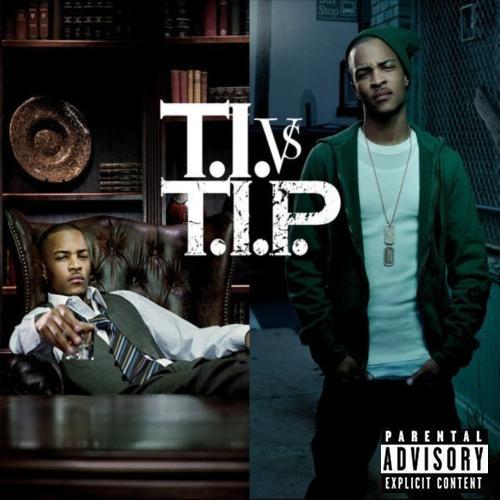
Buy this album from Amazon.com---87 used & new available from $9.49
Usually, concept albums are rarely a good idea and a rap concept album is pretty much doomed from its inception. That is unless you’re T.I. then you might be able to pull it off.
On his 5th studio album, T.I. vs T.I.P, T.I. plays up his seemly split personality. The album is split into three parts. The first belongs to the ex-drug dealer, gangsta persona T.I.P.
The second part is dedicated to the more refined, more business oriented and slightly more level headed T.I. and things culminate with the ultimate battle between the two during the finale.
The album opens with a rather entertaining intro that finds T.I.P overtaking T.I., expressing disillusionment with the rap game and telling off virtually everyone important at his label.
It then proceeds into the summer’s slow burning hit “Big Things Poppin’ (Do It) produced by noted hip hop producer Mannie Fresh. The rest of the T.I.P portion proceeds with pretty much the same I’m-a-dope-boy-and-if-you-even-look-at-me-the-wrong-way-I’ll-kill-you subject matter.
While this is nothing different from most other rap albums, T.I. finds a way to still make it refreshing. It also helps that he has hip hop royalty such Jay-z and Busta Rhymes making guest appearances on songs like “Watch What You Say To Me” and “Hurt” respectively.
This section of the album does have its shining moments like “Da Dopeman” where T.I. explains that contrary to what your favorite rapper says, selling drugs is not all fast money and fast women. There are real consequences.
Act two opens with yet another intro; these are arguably the best part of the album. This time T.I. is in charge. The urgent sounding Just Blaze produced “Help is Coming” finds him making the bold assertion that he can save hip-hop. Which is probably true because T.I. was one of the few rap acts to go platinum last year.
The second set also finds an odd pairing with ex-Fugee Wyclef Jean on the relaxed “My Swag”. As weird as this might sound it actually works. One collabo that doesn’t work, however, is “Show It To Me” with Nelly. The live instrument backing is just a little too out of place.
One of the ways, this part of the album differs from the first is the choice in music. While the first part is filled with hard banging beats that are reminiscent of earlier T.I. albums such as Trap Muzik and Urban Legend. The second set of songs finds him rapping over more progressive and diverse beats.
The subject matter is also completely different. Gone are the street tales and threats. This set explores more of T.I.’s current lifestyle. He does this by name dropping expensive brands from cars to clothes and talking about life in the lap of luxury.
While this part of the album is not as cohesive as the first part, despite it’s misses it’s still entertaining. He also manages to pull Eminem out of self imposed retirement for a verse on the track “Touchdown”.
Act three is really where things get interesting. In “Tell Them I Said That” T.I. calls out rappers that feed their fans false stories of street life. On “Respect This Hustle” the confrontation between the two sides unfolds.
Complete with both sides addressing each other at the beginning and end of the song. Both T.I. and T.I.P set out to prove to each other they are good at what they do. While it’s a good idea in theory, in practice it’s pretty anticlimactic.
T.I. vs T.I.P. is filled with some refreshing and creative moments, however, it failed to live up to all the hype that surrounded its release. Although it falls short in some areas, it’s still fun to hear these two go at it.
